Showing posts with label Olive Senior. Show all posts

Wednesday, March 9, 2022

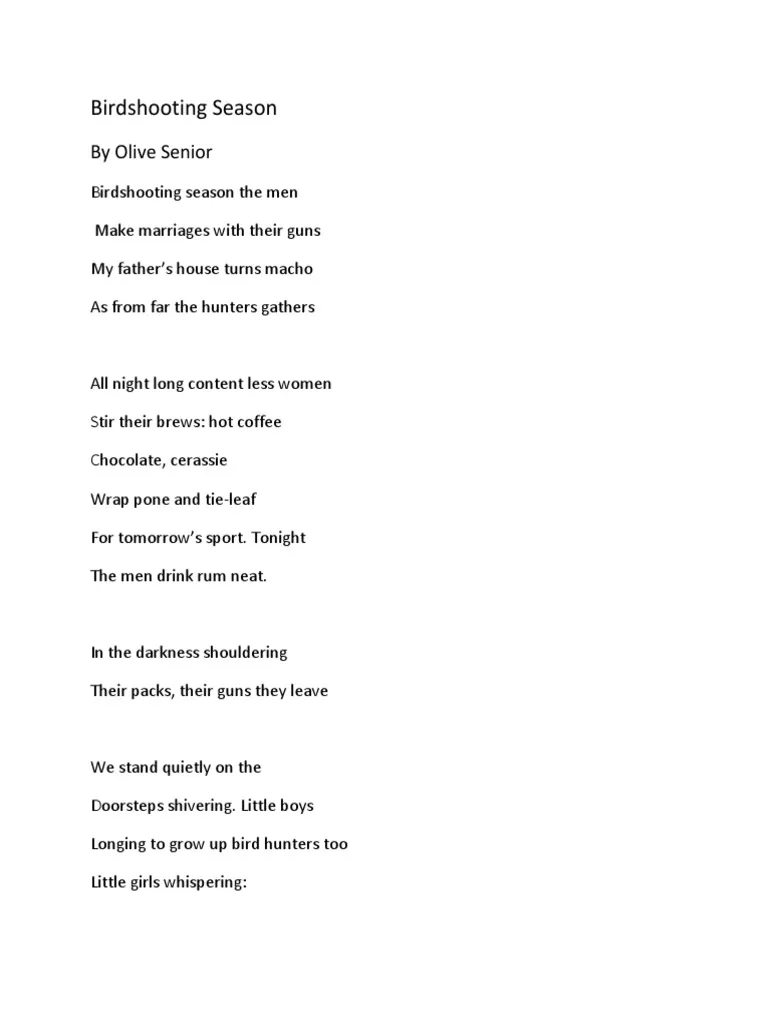
Birdshooting Season By Olive Senior

Birdshooting Season[The other poem you are going to hate because of it's overuse by teachers and questions- this and the theme of love and family relationships become traumatizing]


Figurative Devices

  •     Metaphor –

Examples: “Men make marriages to their guns” not literal marriage but shows the close, needed, and the relation the men had with their guns now that it is bird shooting season, you need your gun to shoot so the gun was held in high importance.


  •      Imagery-

Examples: “in darkness shouldering their packs, their guns they leave” we can imagine the scene of the men cloaked in darkness with guns in hand and their sacks on their back leaving in the night to go hunt.

 “We stand quietly on the doorstep shivering” again another image where we can picture the young children standing feeling the cold air, shivering as they watch the men leave.


   Possible Themes 

  •     Gender roles

  •     Children’s curiosity

  •     Childhood experiences

  •     Nature

Summary

The persona (likely a young girl due to their attention to the details of the women's emotions) describes the beginning of birdshooting season. Men gather from far and wide to the house of the persona's father, influencing an atmosphere of manliness and machismo. The preparations of both the men and the women are described through the eyes of the child. Women prepare tea and coffee for these hunters and make food for them as they set forth on this seasonal exodus, with neither thanks nor acknowledgement. The little boys all dream of becoming bird hunters like their fathers, while the little girls encourage the birds to fly away, as though hoping that they themselves, like the birds will escape the fearsome grasp of the bird hunting men and the resulting cycle. The themes include gender roles, nature and childhood experiences. The mood is reflective.


Analysis

"Birdshooting season the men make marriages with their guns"

The poem begins with the titular phrase 'birdshooting season,' communicating a yearly/seasonal time period during which men go out for shooting birds. The poet uses a combination of alliteration and metaphor in "men make marriages with their guns." The repetition of the deep, manly 'm' sound sets up birdshooting season as a time meant mostly for the enjoyment of men and for them to display their male prowess. The metaphor 'make marriages with their guns' conveys the care and attention they give to their guns, as though actually marrying them. Thus, they prioritize the condition of their guns, doting on them like in marriage- as they are, they are the primary tools they need to work in union with for bird shooting.


"My father’s house turns macho  as from far the hunters gather"

The persona's father's house 'turns macho' with the influx of several men. To be 'macho' is to be manly in an excessively aggressive or assertive way, so it appears that with the flocking of men from far and wide to one home, their masculinity has built upon one another's, becoming more and more assertive to the point of machismo.


"All night long contentless women stir their brews: hot coffee chocolata, cerassie wrap pone and tie-leaf for tomorrow’s sport. Tonight the men drink white rum neat."

The women are described here as 'contentless,' meaning they are dissatisfied or unhappy. This is likely due to the fact that they must stay up all night preparing the beverages and food for these men without thanks, only for them to depart for a long period of time to shoot birds. As the men have made marriages with their guns, they have neglected care for their wives and children. The women must stock them up with food and drink year after year without acknowledgement from their husbands. The poem alludes to a slew of traditional Caribbean drinks and foods, and it is said that the men drink 'white rum neat,' meaning white rum undiluted at full strength. This again communicates the assertive machismo of the men, showing off their masculine resistance to strong alcohol.


"In darkness shouldering their packs, their guns, they leave"

The men now leave in the darkness of early morning carrying the guns they so dearly cherish and the packs holding food and drink. There is no mention of acknowledging anyone other than themselves.


"We stand quietly on the doorstep shivering. Little boys longing to grow up bird hunters too Little girls whispering: Fly Birds Fly."

Shivering in the cold morning air, boys seem to idolize the birdhunting men, hoping to become like them in the future. By contrast, the girls hope for the birds to fly away, whispering encouragement for them to escape. This reflects a more empathetic and caring sentiment that is contrary to the aggressive masculinity of the men. This could also be because birdshooting takes their fathers away for a simple sport, and they can see themselves in the birds, being grasped by an endless cycle surrounding a ritual of bird shooting for the enjoyment of men



The Two Grandmothers By Olive Senior

Two Grandmothers


The Two Grandmothers [Clearly we can Tell I liked this poem... because of Towser...]


 The point of view used was the child narrators or first person point of view.

Setting;

  • Jamaica, Rural Village and an urban city/town.


Social challenges;

  • Pearlie is a child but has to act like an adult.

Economic Challenges;

  • Poverty; Pearlie is from a poor family.


→ The narrator is exposed to these experiences at Grandma’s Del. The situation with Pearlie paints a negative picture of rural life in Jamaica. The narrator, being young, does not fully understand Pearlie’s situation but still pitties her.

 The reader first meets her when she is a little girl.

  • She grows and matures as the story progresses, by the end of the story she appears to be a teenager.

  • She initially prefers the company of Grandma Del, but as she grows up, she begins to show a preference for Towser.

  •  She reports a lot of sensitive information, for example – the ‘fall’ of grandma Del, Pearlie’s home situation, Eulalie and Ermandine’s pregnancies – but does not appear to understand the gravity of the various situations.

  • As she grows up, she appears to become more materialistic in her desires, she wants to be like every-one else.

  • She appears, by the end of the story, to be confused about how to feel about her physical appearance.

  • She cannot be bothered with her country grandmother, grandma Dell, by the end of the story.

  • She begins to appreciate her hip socialite grandma Elaine, aka Touser, by the end of the story.


→ In the beginning of the story, the narrator is exposed to positive aspects of rural Jamaican lifestyles. For instance, she went to church, her grandmother Del made her dresses and bonded with her by cooking and sewing. At this stage in the narrator's life she enjoyed these visits.


  • SUMMARY

  • The story opens with a little girl telling her mother about her experiences with her two grandmothers; grandma Dell and grandma Elaine a.k.a Towser. Grandma Dell is her ‘country’ grandmother who lives in rural Jamaica, raises livestock, caters to her community,  takes her grand daughter to church and is enamored by her grand daughter’s ‘pretty’ skin and hair. Grandma Elaine, on the other hand, is her ‘town’ grandmother. She has had multiple marriages, is a socialite who dates wealthy men, travels, and is very concerned about her physical appearance. The granddaughter, initially, prefers her country grandmother, who is very attentive to her needs and loves to ‘show her off’ to her friends and neighbours. However, as the story progresses, and the narrator ages and matures, she begins to prefer her town grandmother, who is more cosmopolitan and appreciative of material things. With her change in attitude to grandma Dell, however, also comes a change in attitude to her country friends. They are no longer figures who inspire awe, but girls to look down on as ‘less than’. The story closes with the teenage narrator proposing that her family should spend a day with her country grandmother – then she would be taken care of until next year – ensuring that they have more time to spend with Towser (Grandma Elaine) as well as pursue more interesting exploits.


Themes Used;

  • Childhood Experiences

  • A young girl visits her two grandmothers who live in different areas of Jamaica. The story chronicles the girl’s growth and development as a character.

  • Love and Family Relationships

  • The  grandmother-Granddaughter relationship is the focus of the story

  • Tradition VS Modern

  • Grandma Del VS Grandma Elaine


Traditional

Modern

Grandma Del

Grandma Elaine (Towser)

  • Christian minded and simple in her approach to life- Religious; She goes to church, as well as teaches her granddaughter lessons from the bible.

  •  Hypocrite; Making stewed guavas and glass jars of marmalade; This shows her grandmother allows her to help.

  •  Traditional/ old fashion;  Puts castor oil in her granddaughter's hair to keep it natural. She has no electricity but has an old lamp.

  • • Prejudiced Encourages grand daughter to be proud of her dark skin colour and to cherish herself.

  • Read stories to her granddaughter.

  •  Altruistic Grandmother tells her to wear dresses.

  • No makeup is allowed.

  • Go to sleep early.

  • Likes to spend time with granddaughter


  • Non-traditional/ Socialite; She does not go to church nor follows any religious teaching. Though she likes to socialize, dress up and go out with her friends.

  •  Blunt and speaks her mind;  She doesn't like to cook or do domestic chores.

  • Materialistic and prejudiced;  Towser makes her granddaughter dress up and wear makeup, as well as take care of her skin like an adult.

  • Presses her hair.

  • Tell the child to call her by her name Towser.

  •  Prejudiced; She tells the child to relax her hair so it will be straight.

  • Says the child would have been prettier if she had lighter skin.

  • Narcissistic; Likes to stay out late and swears and curses in front of the child.

  • She Married multiple times and likes to go out on dates;

  • Mister Kindade

  • Mister Samuel

  • Mister Blake


THEMES USED; 

  • Racial Prejudice

  • This theme is highlighted by Grandma Elaine/ Towser and the Clearwater relatives. Grandma Elaine highlights this theme by her reference to the narrator’s hair; ‘your mother had better start to do something about your hair from now it’s almost as tough as your father’s …. If you were my child I would cut it off to get some of the kinks out.’ (Senior, 119) and skin tone; ‘Joyce says Grandma is sorry I came out dark because she is almost a white lady and I am really dark.’ (Senior, 120). The grandmother’s preoccupation with the fact that her grand daughter has predominantly black features highlights the theme of racial discrimination. She sees these features as flaws and passes this sentiment on to her grandchild. We see the child questioning if being dark is a bad thing ‘Is dark really bad, Mummy?’ (Senior, 120).


  • This is in contrast to the country grandmother, Grandma Del, who re-enforces the very opposite view of Grandma Elaine. She believes that her grandchild’s hair is beautiful ‘Grandma loves to comb my hair. She says it’s so long and thick and she rubs it with castor oil every night.’ (Senior, 117) and her skin is beautiful as well ‘Grandma Del says my skin is beautiful like honey’ (Senior, 117). Despite this positive reinforcement by Grandma Del, it still comes from a place of prejudice. She too, like Grandma Elaine, believes that being too dark and having too much ‘kink’ in one’s hair is a bad thing. The two grandmothers only differ in terms of their idea of what is ‘too dark’, or ‘too kinky’.


  • The Clearwater relatives, particularly Maureen, highlights the theme of racial prejudice. She introduces the term ‘nigger’ to the story. The narrator questions her beauty based on what she observes as beautiful around her, and finds herself lacking; ‘how can I be beautiful? My skin is so dark, darker than yours and Maureen’s and Jason’s and Auntie Rita’s. And my hair is so coarse, not like yours or Maureen’s but then Maureen’s father is white. Is that why Maureen called me a nigger?’ (Senior, 124). The narrator declares that she hates Maureen, based on the before mentioned incident, but, ironically, she wants to be like Maureen and is even more ashamed of her hair. 


  • Social Prejudice

  • This theme is highlighted by Grandma Elaine, Grandma Dell, and the narrator. Grandma Elaine has a distinct disdain for Grandma Dell. She believes that ‘granny Del’ is a country bumpkin from the ‘deepest darkest country’ (Senior, 118). She sees her as irrelevant and believes that she is brainwashing her grandchild with information that is not only irrelevant, but embarrassing as well. This disdain comes from the fact that Elaine is a socialite whose world is the direct opposite of the simplistic life that Grandma Del leads. Grandma Elaine dates rich white men, travels, and ensures that she maintains her beauty. She views Grandma Dell with scorn because she does not do the same.


  • The reader receives no inkling of Grandma Del’s feelings toward Grandma Elaine, but we are treated to the judgement that she quietly metes out to her neighbours in the country. She views Ermandine and Eulalie as ‘a disgraceful Jezebel-lot and dry-eye’ (Senior, 121) because they have disgraced their parents by getting pregnant. She views them as being beneath her, despite the fact that she also did the same, and was also shunned by the community for a period of time.


  • The narrator, in turn, adopts the prejudices of both grandmothers. She starts to dislike going to the country because ‘there’s nobody but black people’ (Senior, 123) there. She looks down on her friends – Ermandine, Eulalie and Pearlie – due to their multiple pregnancies and bedraggled state. She starts to literally avoid them because she does not want them to ask her for some of her clothes.  Everything about being in the country (rural area), from the people to her experiences, annoys her – in her teen years – because visiting the country is shameful in relation to going to Europe or America. It is not considered to be a socially relevant activity.

  • Love and Family Relationships

  • Both grandmothers love their grandchild, and she loves them in return. Grandma Del shows her love by combing her granddaughter's hair, taking her to church, steering her away from negative influences, and educating her about appropriate behaviour. Initially, this education is appreciated and accepted by the narrator, but as she grows up and matures, she views this show of love as stifling and irrelevant. The narrator does not love her grandmother any less, it is just that their point of views no longer align.


  • Grandma Elaine, on the other hand, shows her love for her grandchild by highlighting her flaws and seeking to improve them. Therefore, she points out that the child’s hair is kinky and her skin is too dark. Undoubtedly, this is an inappropriate conversation to have with a small child, however, this is her flawed way of showing her love. She suggests activities for improving the child’s social prospects such as finishing school and visits off the island. The narrator returns this love by eventually placing Grandma Elaine as the favoured grandmother. She even adopts, eventually, her materialistic sensibility.

  • Women in Society


This is a narrative about mothers, the values they instill in their children, and how they treat one another. In the, there are women of all social statuses and financial origins who all contribute to this issue. Grandma Elaine has a high social rank, and she looks down on Grandma Del, who has a lower social status. Grandma Del, on the other hand, looks down on Eulalie, Ermandine, and Pearlie because they are impoverished and victims of their financial and social circumstances. The narrator participates in this cycle by shaming her 'country' friends and thinking of herself as superior to them. Strangely, she is treated the same way by her cousin, Maureen, who also treats the narrator as "less than." This story's possible moral is that women should endeavor to understand and appreciate one another.

  • Innocence vs. Loss of Innocence


As a child, the narrator reports on the activities of others without fully comprehending what is going on. This is what it means to be innocent. She also finds the good in people and embraces them for who they are. This can be demonstrated in her admiration for Eulalee's culinary abilities, as well as her acceptance of Ermandine and Pearlie's children. She simply took it without hesitation. As the youngster grows older, she begins to think of herself as superior to her peers. This is due to the fact that her circumstances are better than theirs. This represents the loss of innocence that comes with age.


West Indies U.S.A by Steward Brown

West Indies U.S.A[The under dog poem that deserved more tbh] West Indies, U.S.A.  Stewart Brown  Cruising at thirty thousand feet above the ...